
The Transformation of War Wrought by the Armies of the French Revolution and Napoleon

In the years before the French Revolution, warfare in Europe was moribund at best.  The wars of the period were dynastic wars fought to maintain the traditional balance of power and were generally limited in scale and scope.  The armies of this era were professional armies with an aristocratic officer class and private soldiers drawn from the lowest segments of society and subject to brutal discipline.  Desertion and looting were rife in the pre-revolutionary or old regime army’s, which partly explains the discipline, the other part of the discipline equation was the need for soldiers to execute their battlefield actions in concert to maximize the effect of their weapons. [1]  Lastly, pre-revolutionary eighteenth century warfare was characterized by small field armies, reliance on depots for supplies, mechanistic battlefield evolutions, and wars for limited gains.

After French defeats in the Seven Years War against the Prussians, the French army began to look inward to discover the cause of their defeat.  This led some officers, notably Jean-Baptiste de Gribeuval and Count Jacques de Guibert to propose reforms in the way the French army was organized, equipped, and the way it fought.  Some of these reforms such as the artillery reforms of Gribeuval were begun before the revolution.  Other reforms such as the tactical and organizational changes proposed by Guibert were not successfully introduced until after the French revolution.

The way wars were fought was overthrown by the French Revolution.  The wars of the First and second Coalition were not fought to maintain the balance of war, rather they were fought by the French to first defend their revolution and later to export it the revolutionary ideals to the other peoples of Europe.  This does not explain French success in the wars fought during the early years of the revolution.  The French success benefited from the far thinking reforms began by the aristocratic officers in the last years of the Ancién Regime, reforms that were only fully implemented after the revolution and were suited to the type of soldier in the new French army.

One of the major changes of the French revolutionary armies is their tactical style of fighting.  The French did not fully abandon the line as their tactical formation of choice but they did incorporate new formations into their assault doctrine that gave them greater flexibility on the battlefield.  The assault column is the formation most widely cited as being peculiar to the French armies early in the revolutionary period.  The column formation itself however is like many of the tactical developments of the revolution, a product of pre-war French military thinking.  The column-in-line formation was codified in French doctrine in 1791 but it had been theorized as early as 1772 by Count Jacques de Guibert of the French Royal Army.[2]

The French use of the column for assault was a revolutionary change in tactical battlefield maneuver.  Doctrine throughout Europe held that the line-of-battle was the only effective method of attacking because it maximized the fire of assaulting infantry.  The French initially experimented with column formation in 1792 but its initial use was a failure and it was not revived until 1794.[3]  However, once the French armies were trained and particularly after the creation of amalgamated demi-brigades under Carnot, the column of attack was used successfully throughout the revolutionary and Napoleonic era.  The column in the attack was almost a French signature during this era.  When the French attacked in column they were able to attack as they marched this meant that almost no pause was necessary to move from the march to the attack.  Attack in column allowed the attacking army to deploy faster than defenders could get into line-of-battle; it also allowed the attacker to maneuver rapidly both on the battlefield and around the flanks of an enemy army.

Attack in column was not the only tactical innovation of the French; initially the French also made greater use of skirmishers than the other continental armies.  Skirmishers were individual soldiers who preceded the line-of-battle and engaged targets of opportunity in the enemy line in an effort to both cause casualties and spread confusion.  Skirmishers were used by the other armies of Europe but never in great numbers because of the makeup of the common soldiers and their propensity to desert.  Revolutionary soldiers by contrast were not as prone to desertion as the armies of the Ancién Regime had been.[4]

The idea of using a mass of skirmishers was first proposed by Lafayette based on his experiences of the effectiveness of them in the American Revolutionary War.  He did get a rifle company introduced into each battalion but because of the difficulty of producing the weapons, rifle armed skirmishers did not become widespread until around 1830.[5]  This did not stop the French from using masses of musket armed skirmishers in front of their battle line and using them to harass their opponents prior to launching their main attack.

They also organized their army into divisions that could maneuver independently.  A division was composed of infantry, cavalry, and artillery and numbered between 10,000 and 16,000 men.  The division was big enough that it could fight on its own until the other divisions of the army joined up.

The royal army had pioneered new methods of cannon manufacture and mounting that were also only implemented after the revolution.  The French advances in artillery were the result of the work of Jean-Baptiste de Gribeuval, who implemented radical changes in the way French cannon were manufactured as well as mounted to their carriages in the years prior to the revolution.[6]  These changes made cannon both lighter and more mobile.  For the first time it was possible for cannon to be maneuvered effectively on the battlefield.

The capabilities of the new cannon were not fully exploited until the revolutionary era.  This was simply because the French aside from their assistance to the English colonists in the American Revolution did not fight in any major wars between the Seven Years War with Prussia and the War of the First Coalition.  The current trend in historical thought that the military reforms of the Revolution had their genesis in the pre-revolutionary French Royal Army is almost certainly correct.[7]  Addington specifically attributes these reforms to the Ancién Regime and Parker, Brodie, and Blanning expand on it too.  This theory does not take away from the accomplishments of the French armies of 1792-1794.  The armies of the early revolution were hurried creations that did not have the benefit of the training, drill, or the leavening of veterans that would happen under Carnot starting in 1794.  Given the rawness of the early levies, it is astonishing that the revolution was not crushed by the First Coalition.

The French revolutionary armies were the beneficiaries of the reformist thought and activities of the later years of the Ancién Regime.  In addition, the citizen armies of France were uniquely suited to exploiting the type of mobile warfare advocated by the reformists.  It was the élan and motivation of the citizen armies that allowed the French to adopt some of the novel reforms proposed during the Ancién Regime.  The widespread use of skirmishers in particular, was only possible because the French did not have to worry as much about their soldiers deserting without close supervision.

It is also important to remember that the French army did not disintegrate after the revolution, many royalist officers left the army, but some also stayed and these officers, combined with the vast majority of common soldiers that also remained provided critical continuity with the old Royal Army.[8]  However, the French Navy by contrast, did suffer greatly from the loss of experienced royalist officers who left the service.  It has been pointed out that revolutionary zeal in the navy was not enough to replace the experience lost after the revolution in the navy.[9]  It took more than desire to be a good seaman, especially in the Age of Sail.  The British demonstrated this time and time again as they regularly trounced French and Spanish fleets whenever they engaged them during the revolutionary period.

Current historical thought holds that the French Revolutionary army was the beneficiary of the reform that started in the French Royal Army after their defeat in the Seven Years War.  This is arguably the correct interpretation.  It is also just as correct to point out that it was the only the greater cohesion, morale, motivation, and devotion of the revolutionary soldiers that made implementation of these reforms a realistic possibility.  In short, it was the fusion of the zeal of revolutionary soldiers and the forward thinking of pre-war theorists that made the French Revolutionary Army such a successful military instrument.

Bibliography

Adams, George. The Growth of the French Nation. New York, NY: The Macmillan Company, 1912.
Addington, Larry. The Patterns of War Since the Eighteenth Century. 2nd. Bloomington, IN: Indiana University Press, 1994.
Blanning, T.C.W. The French Revolutionary Wars: 1787-1802. New York: St. Martin’s Press, 1996.
Brodie, Bernard, and Fawn Brodie. From Crossbow to H-Bomb: The Evolution of the Tactics and Weapons of Warfare. Bloomington, IN: Indiana Unveristy Press, 1973.
De Tocqueville, Alexis. The Old Regime and the French Revolution. Translated by Stuart Gilbert. New York: Anchor Books, 1955.
Jones, Archer. The Art of War in the Western World. New York: Oxford University Press, 1987.
Parker, Geoffrey, ed. The Cambridge History of Warfare. New York: Cambridge University Press, 2005.
Preston, Richard A., Alex Roland, and Sydney F. Wise. Men in Arms: A History of Warfare and Its Interrelationships with Western Society. 5th Edition. Mason, OH: Thomson-Wadsworth Publishing, 2005.
Von Clausewitz, Carl. On War. Edited by Michael Howard and Peter Paret. Translated by Michael Howard and Peter Paret. Princeton, NJ: Princeton University Press, 1976.


[1] Parker, Geoffrey, ed. The Cambridge History of Warfare: Cambridge University Press, 2005. p. 180
[2] Ibid. p. 194
[3] Preston, Richard A.; Roland, Alex; Wise, Sydney F. Men in Arms: A History of Warfare and Its Interrelationships with Western Society. 5th Edition. Mason, OH: Thomson-Wadsworth Publishing, 2005. p.161
[4] Blanning, T.C.W. The French Revolutionary Wars: 1787-1802. New york: St. Martin’s Press, 1996. p. 87
[5] Brodie, Bernard; Brodie, Fawn. From Crossbow to H-Bomb: The Evolution of the Tactics and Weapons of Warfare. Bloomington, IN: Indiana University Press, 1973. pp. 105-106
[6] Ibid. p. 17
[7] Addington, Larry H. The Patterns of War since the Eighteenth Century. 2nd.  Bloomington, IN: Indiana University Press, 1994. pp. 19-22.
[8] Parker. pp. 195-196
[9] Ibid. p. 210

Loaded Cannon in NYC

Aside

This is a curious item of interest: 18th century cannon in NYC found to be loaded with ammo
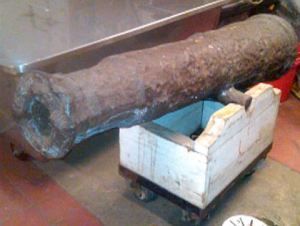
The cannon in Question. Image Courtesy CBSNews

The cannon in Question.
Image Courtesy CBSNews

Recently, a Revolutionary era cannon from a British warship that had been on display in Central Park  until the mid-90′s in New York was found to loaded during restoration efforts.  The cannon was apparently loaded with 2 pounds of black powder and a cannonball.  It was disarmed by the NYPD Bomb Squad after the police were notified.  The powder is claimed to have still been viable.  Now wouldn’t that be a hoot if somebody had figured that out while the cannon on was still on display and fired it.  Would we consider anybody injured a Revolutionary War casualty since that is when the cannon was loaded?

My First Peer-Reviewed Article

I received notification this morning that my first Peer-Reviewed article has been accepted for publication.  It is an annotated bibliography of Frederick the Great for Oxford University Press (OUP) Online and it has taken me awhile to write it up.  The process of writing it is pretty interesting in and of itself and I am going to describe how that went.

I was first contacted by OUP last November asking if I had any interest in writing an article.  The initial contact had the proposed subject and that Dr. Dennis Showalter is the Editor-in-Chief for the project. Because I get blog related spam and fishy requests and offers all the time  emailed Dr. Showalter to find out if it was for real and he assured me that it was whereupon I agreed to the project and started researching and writing.  Writing the first draft took me about 4 months between researching, writing, and doing all the other stuff I have simultaneously going on.  Once I submitted the initial draft it took about 6 weeks for the initial edits and peer-reiew and then another two weeks for me to make revisions and re submit it.

Finally, this morning I got the notification that it has been accepted for publication.  It is milestone for me as it is my first academically peer-reviewed paper.  Not something I though I would ever actually accomplish.  If you look at the OUP page for forthcoming articles mine is scheduled for Spring 2013.

Book Review – Iron Kingom: The Rise and Downfall of Prussia, 1600-1947 by Christopher Clark

This massive tome lays claim to being a complete history of Prussia, and if he doesn’t achieve it, he doesn’t miss it by much. It is fairly large at over 700 pages but Dr. Clark has a pleasant writing style that makes the book easy to read. He is not so much recounting events as using the historical events to tell the story of Prussia.

The book opens with the retelling of the Allies abolishment of Prussia as a political unit in 1947 then goes right to the beginning of Prussia with the establishment of Prussia as a political unit under German sovereignty under the Great Elector in the years just prior to the Thirty-Years War. He follows the history of Prussia from its initial conquest by the Teutonic Knights to its incorporation as part of Brandenburg during the Reformation and the conversion of the Knights to Lutheranism. He then traces the the way in which the Elector of Brandenburg got the rights to call himself King in Prussia to King of Prussia and eventually Emperor of Germany.

Almost half the book covers the history of Prussia from the Napoleonic Wars onward. This makes it a little unbalanced in my opinion, but it is also understandable as there are many more records from then forward and it is easier to know what happened. I especially like that the author refuses the temptation to speculate on the might-have-beens as I call them. He points out events that he thinks were pivotal but does not devote space to discussing the what-ifs had different decisions been made. He presents a straightforward recitation of the events of Prussian history in an entertaining manner that also lets the reader make up his own mind about causes because the retelling of events themselves are extremely well balanced.

In conclusion, Dr. Clark has written what is perhaps the best one-volume history of Prussia I have found. I especially liked it’s focus on Prussia as being the dominant factor in German history, and it was. This is an extremely readable book that is useful to both academics and non-academics alike. It should be on the bookshelf of anyone who considers himself a student of German history.

Napoleon & the French Army of Italy 1796

The French Army in Italy was a failing army but was revitalized in 1796 by the arrival of Napoleon and his dynamic leadership style that allowed his soldiers to realize their potential.  The soldiers were unpaid and underfed; they were clothed in rags and often had no shoes.  The artillery park was not maintained properly and the cavalry had unsuitable mounts, if any.  The soldiers in the army were suffering from malnutrition and illness to such a degree that out of a paper strength of 42,000 only 30,000 soldiers were considered battle ready.[1] The hospitals were overflowing and non-battle deaths numbered in the hundreds per month.  Napoleon’s arrival in March of 1796 was to initiate a turnaround in this army that would see it become the elite fighting force of the French army.In 1795 Napoleon had drawn up plans for the invasion of Italy which he had forwarded to the Directory that approved and forwarded them to General Laono Scherer the commander of the army in Italy.[2] Scherer replied to the Directory “that the man who had drawn up the plans should carry them out.”[3] Shortly thereafter, infuriated by the Directory’s pressure, he resigned and Napoleon was appointed to replace him.[4]

Napoleon arrived in Italy and took command on March 27th, 1796.  The conditions he found upon arrival were atrocious; the army was unpaid, underfed, and falling apart.  In fact, on the day of his arrival he had to deal with a battalion that had mutinied.  He reacted forcefully, court-martialing the commander and disbanding the unit.[5] Napoleon showed his skills by turning the mob that was the French army in Italy into an effective force in less than six weeks.

Napoleon did much to reform the army; he demanded that the Directory send him money to pay the soldiers and when they failed to do so he used his own methods to get money to pay them.  He had his generals scour the countryside for funds and secured loans to pay his troops.  It was also at this time that he showed the strength of his oratory and presaged his future policy of living off the land in conquered territory.   His pronouncements to the troops on March 27,th 1796, read, “Soldiers, you are naked, ill fed! The Government owes you much; it can give you nothing. Your patience, the courage you display in the midst of these rocks, are admirable; but they procure you no glory, no fame is reflected upon you. I seek to lead you into the most fertile plains in the world. Rich provinces, great cities will be in your power. There you will find honor, glory, and riches. Soldiers of Italy, would you be lacking in courage or constancy?”[6]

When Napoleon arrived in Italy he did not get to pick the divisional commanders or army staff; he had to use the men already in those positions.  It is a testament to the overall quality of the Republican armies that most of the officers would prove to be excellent soldiers when given proper leadership.  The outstanding officers, who would truly come into their own under Napoleon,  present in Italy included five future Marshals of the Empire Massena, Augerau, Serurier, Marmont, and Berthier, possibly the most able Chief-of-staff in history.  All of these officers had done well under the Republic but they were to show their true abilities under Napoleon.

The French forces in Italy were in a bad position when Napoleon took command they had invaded Italy in 1795 and moved up the coastal plain from Nice (see map 1).  They were positioned in coastal enclaves but the French with 33,000 were outnumbered by the combined Sardinian and Austrian armies of 56,000.  Napoleon’s plan for continuing the invasion would rely on the judgment and execution of his soldiers and subordinates for success.  He would attempt to use the Army of Italy to split the forces opposing him and use the resulting opportunity to defeat them in detail or force their retreat.

A little over a month after taking command Napoleon had done what he could to remedy the army’s situation and planned an offensive to begin on April 15th , 1796.  The Austrians got the jump on him, however, and attacked him on the 12th near the villages of Bric Castlas and Montenott on the road to Dego from Savona.  Napoleon reacted by ordering Laharpe to conduct a frontal assault on Montenott while Massena would maneuver to take the Austrians under Argentau in the Flank near Bric Castlas.  This maneuver worked flawlessly and the Austrians were routed with Argentau withdrawing to the north.  Out of some 4,000 Austrians engaged, Argentau could only muster some 700 the following day they were so thoroughly routed.[7]

On the 13th, the French continued their advance to Dego but were stopped short of the town when Massena found it occupied by the Austrians with about 4,000 troops.  On April 14th , 1796, the French began their assault on Dego using what would become a signature tactical strategy for Napoleon.  He ordered the division of Augerau to hold the enemy with frontal attacks while Massena would maneuver to take the Austrians in the flank.  After a hard fought battle, a brigade from Massena’s division took Dego at the end of the driving the Austrians out.  During the night, the French soldiers gave themselves over to plunder and looting so that when the Austrians under Vukassovich counter-attacked with five battalions on the 15th they were driven from the town, forcing Napoleon to redeploy Augerau’s division to retake the town in essentially the same manner as the previous day.[8]

This was Napoleon’s first campaign in independent command and it showed several things that would prove true during the next twenty years.  Napoleon had shown what French soldiers could do when adequately led, motivated and supplied.  Although there was one breakdown in discipline that could have been disastrous, Napoleon dealt with it without the episode affecting his entire army.

The French army of Italy was homogenous in quality with other French armies before Napoleon took command; it had enjoyed limited success but with uninspiring leadership and little attention paid to taking care of the troops was beginning to fade away into uselessness.  Napoleon arrived and immediately took the situation in hand, working to improve the soldiers’ situation through better supply and giving them more motivation.  One of the hallmarks of Napoleon and his successful subordinate’s command style is that they led from the front accepting the same dangers as their men.

Napoleon also had his army live off the land as they conquered new territory which was his only reasonable recourse given his lack of support in this area from the Directory.  While Napoleon was undoubtedly one of the greatest military commanders of all time leadership ability alone is not enough.  Much as you don’t pound a nail with a hot dog, good soldiers are necessary for success in wartime and that is what Napoleon had.  It is the combination of competent and motivated soldiers with exceptional leadership that let the French achieve what they did.

Principalities of Northern Italy in 1796-University of Texas at Austin Library, Perry-Castañeda Library Map Collection, Historical Maps of Europe, Northern Italy, 1796 (for the campaigns of 1796-1805), @ http://www.lib.utexas.edu/maps/historical/history_europe.html#I

Napoleon did what no other French commander could have done in 1796.  He took a failing army and, by providing leadership and care for soldiers’ needs, combined with solid tactical and strategic thought, turned it into an excellent offensive machine.  By the spring of 1797 he would have conquered all of northern Italy, invaded Austria and forced the Austrians to sign an armistice the Treaty of Campo Formio the ending the wars of the First Coalition.

Bibliography


Alexander, Bevin. How Great Generals Win: A Military Historian Appraises the World’s Greatest Commanders, from Hannibal to MacArthur.  New York, W.W. Norton & Co. LTD, 1993.

Asprey, Robert. The Rise of Napoleon Bonaparte. New York: Basic Books, 2000.

Bubelis, Raimund, Pearce, Glenn, eds.. Napoleonic Miniatures Wargame Society of

Toronto, Italian Campaign : 1796-1797 : Defeat of Piedmont. http://www.napoleonicminiatureswargame.com/piedmont.html

Burbeck, James. The French Revolt and Empire. The War Times Journal Online http://www.wtj.com/articles/napsum1/

Burnham, Robert. ed., The Napoleon Series, www.napoleon-series.org

Chandler, David G. ed., Napoleon’s Marshals, New York, Macmillan, 1987

Connelly, Owen  Blundering to Glory: Napoleon’s Military Campaigns. Wilmington, Delaware: Scholarly Resources Inc., 1987.

Delage, Irène, Huguenaud, Karine, Hicks Peter eds., Napoleon.org, The Fondation Napoleon, www.napoleon.org

Durant, Will & Ariel, eds.  The Age of Napoleon:  A History of Civilization from 1789 to 1815, The Story of Civilisation Vol. IX, New York, New York, Simon & Schuster, 1975

Forty, Simon & Swift, Michael, ed.  Historical Maps of the Napoleonic Wars, New York, New York, Sterling Publishing Co., Inc., 2003

Godlewska, Anne Marie Claire, Schauerte, Paul, Paul, Godlewski, Al-Nasir Hamir, de Villele, Marie-Anne Corvisier, Ponnou, Claude eds., Atlas of Napoleonic Cartography in Italy, http://geog.queensu.ca/napoleonatlas/

Holmes, Richard ed., The Oxford Companion to Military History, New York, Oxford University Press, 2001

Kreis, Richard, The History Guide, Napoleon’s Proclamation to His Troops in Italy (March-April 1796), http://www.historyguide.org/intellect/nap1796.html

Moore, Richard, The Napoleonic Guide, www.napoleonguide.com

Napoleon, His Army and Enemies.
Armies, Campaigns, Battles, Tactics, Commanders, Napoleon’s Lightning Italian Campaign.
1796 – 1797
, http://web2.airmail.net/napoleon/italian_campaign.htm

Newark, Tim ed., Rifleman: Elite Soldiers of the Wars against Napoleon, London, U.K., Publishing News Ltd., 2000

University of Texas at Austin Library, Perry-Castañeda Library Map Collection, Historical Maps of Europe, Northern Italy, 1796 (for the campaigns of 1796-1805), http://www.lib.utexas.edu/maps/historical/history_europe.html#I

Endnotes


[1] Asprey, Robert, The Rise of Napoleon Bonaparte, (New York, Basic Books, 2000), p. 125

[2] Chandler, David G. ed., Napoleon’s Marshals, (New York, Macmillan, 1987), p.272

[3]Asprey, p.126

[4] Napoleon, His Army and Enemies.
Armies, Campaigns, Battles, Tactics, Commanders, Napoleon’s Lightning Italian Campaign.
1796 – 1797
, http://web2.airmail.net/napoleon/italian_campaign.htm

[5] Asprey, p. 125

[6] Kreis, Richard, The History Guide, Napoleon’s Proclamation to His Troops in Italy (March-April 1796), http://www.historyguide.org/intellect/nap1796.html

[7] Bubelis, Raimund, Pearce, Glenn, eds., Napoleonic Miniatures Wargame Society of Toronto, Italian Campaign : 1796-1797 : Defeat of Piedmont, http://www.napoleonicminiatureswargame.com/piedmont.html

[8] Burnham, Robert ed., The Napoleon Series, www.napoleon-series.org