
The First Battle of Manassas – 21 July, 1861

First Manassas or First Bull Run as it was called in the North was the first major battle between land forces of the Civil War.  The outcome of the battle also set the general pattern for battles in the first two years of the war. That pattern being tactical Union defeats with the Confederacy being incapable of following up on the strategic opportunities presented by their victories. Forces Involved: Union – 28,450 troops under BG Irvin McDowell Confederate – 32,230 under BG Joseph Johnston and BG P.G.T. Beauregard A key point is to remember that uniforms were not standardized on either side this early in the war. Both armies looked … More after the Jump…

The Battle of Messines Ridge – 1917

From the opening months of the World War I, Flanders was the decisive sector for the British Army.  It was in an around the medieval Belgian town of Ypres that the original BEF had decimated themselves fending off German attacks from October to December, 1914.  Ypres and the salient surrounding it was where the British would see the hardest and most prolonged fighting of all the places where the British would fight in World War I. The Battle of Messines Ridge fought from 7-14 June, 1914 was not really a separate battle at all but rather the opening phase of what would come to be known variously as the Third … More after the Jump…

Book Review: The Bombers and the Bombed: Allied Air War Over Europe 1940-1945 by Richard Overy

[FULL DISCLOSURE: I received my copy of this book free from the author. I was not paid for this review and the opinion expressed is purely my own] The Bombers and the Bombed: Allied Air War Over Europe 1940-1945 is one of those books that is going to end up a standard work for a long time to come.  It is the single most comprehensive history of the Allied bombing of Germany and occupied Europe during WWII that I have seen since the strategic bombing survey published by the US government in the immediate post-war years. I have a review copy of the book so the page counts may be a … More after the Jump…

D-Day 70th Anniversary

Just a reminder for everyone to stop today and take a moment to reflect on the events that happened 68 years ago today on the shores of Normandy in France.   This is the day that the Allies opened up the long-awaited Second Front against Hitler’s Germany.   The invasion took place along almost 50 miles of French coast using five named invasion beaches.   From south to north the beaches were named Utah, Omaha, Gold, Juno and Sword.   The first days objectives were not reached over most of the front and in many places it would take weeks to reach objectives that were supposed to have been taken … More after the Jump…

The Battle of Antietam – 17 September, 1862

The Battle of Antietam is interesting for several reasons the most important of which for me is that it is the single bloodiest day in American military history. There have been bloodier battles in American wars but no single day matches the blood spilled on those Maryland fields that early day in 1862. The Union victory at Antietam, if you can call it a victory, also provided Abe Lincoln with the opportunity to promulgate the Emancipation Proclamation. An executive act that was totally unconstitutional but that he did anyway for domestic and foreign political reasons. Antietam was the final battle of Lee’s first invasion of the North and while it … More after the Jump…

Book Review: D-Day – Minute-by-Minute by Jonathan Mayo

[FULL DISCLOSURE: I received my copy of this book free from the author. I was not paid for this review and the opinion expressed is purely my own] Next Week is the 70th Anniversary of D-Day the Allied invasion of Europe.  I would guess that most people don’t think about it and if they do the picture that comes to their mind is a scene from Saving Private Ryan.  The movie gives a good idea but the words of those who were there are priceless gems in my opinion. D-Day: Minute by Minute is a description of the events of D-day in the order in which they occurred taken from transcripts … More after the Jump…

The Best Military Poem Ever

Simply the best military poem ever written.  Any soldier that does not know their Kipling should be ashamed of themselves and endeavour to correct that failure as soon as possible.

Tommy
By Rudyard Kipling

I went into a public-‘ouse to get a pint o’ beer,
The publican ‘e up an’ sez, “We serve no red-coats here.”
The girls be’ind the bar they laughed an’ giggled fit to die,
I outs into the street again an’ to myself sez I:
O it’s Tommy this, an’ Tommy that, an’ “Tommy, go away”;
But it’s “Thank you, Mister Atkins”, when the band begins to play,
The band begins to play, my boys, the band begins to play,
O it’s “Thank you, Mister Atkins”, when the band begins to play.

I went into a theatre as sober as could be,
They gave a drunk civilian room, but ‘adn’t none for me;
They sent me to the gallery or round the music-‘alls,
But when it comes to fightin’, Lord! they’ll shove me in the stalls!
For it’s Tommy this, an’ Tommy that, an’ “Tommy, wait outside”;
But it’s “Special train for Atkins” when the trooper’s on the tide,
The troopship’s on the tide, my boys, the troopship’s on the tide,
O it’s “Special train for Atkins” when the trooper’s on the tide.

Yes, makin’ mock o’ uniforms that guard you while you sleep
Is cheaper than them uniforms, an’ they’re starvation cheap;
An’ hustlin’ drunken soldiers when they’re goin’ large a bit
Is five times better business than paradin’ in full kit.
Then it’s Tommy this, an’ Tommy that, an’ “Tommy, ‘ow’s yer soul?”
But it’s “Thin red line of ‘eroes” when the drums begin to roll,
The drums begin to roll, my boys, the drums begin to roll,
O it’s “Thin red line of ‘eroes” when the drums begin to roll.

We aren’t no thin red ‘eroes, nor we aren’t no blackguards too,
But single men in barricks, most remarkable like you;
An’ if sometimes our conduck isn’t all your fancy paints,
Why, single men in barricks don’t grow into plaster saints;
While it’s Tommy this, an’ Tommy that, an’ “Tommy, fall be’ind”,
But it’s “Please to walk in front, sir”, when there’s trouble in the wind,
There’s trouble in the wind, my boys, there’s trouble in the wind,
O it’s “Please to walk in front, sir”, when there’s trouble in the wind.

You talk o’ better food for us, an’ schools, an’ fires, an’ all:
We’ll wait for extry rations if you treat us rational.
Don’t mess about the cook-room slops, but prove it to our face
The Widow’s Uniform is not the soldier-man’s disgrace.
For it’s Tommy this, an’ Tommy that, an’ “Chuck him out, the brute!”
But it’s “Saviour of ‘is country” when the guns begin to shoot;
An’ it’s Tommy this, an’ Tommy that, an’ anything you please;
An’ Tommy ain’t a bloomin’ fool — you bet that Tommy sees!
The Battle of Mantinea

The Battle of Mantinea was part of the Great Peloponnesian War (430-404 B.C.). The war was fought in an effort to defeat and contain the growing power of Sparta in Greek Affairs. The war was ultimately a failure as Sparta won in the end and dictated terms to Athens and her allies in the process guaranteeing that Athens would not dominate the Greek world. The prelude to the battle itself was a gathering of Argive Alliance troops who attacked Tegea, about 5 miles south of Mantinea. The Spartans rallied to Tegea’s defense and began to divert a stream to flood Mantinean territory. The main source for the course of the … More after the Jump…

Book Review: No End Save Victory by David Kaiser

[FULL DISCLOSURE: I received my copy of this book free from the author. I was not paid for this review and the opinion expressed is purely my own] No End Save Victory: How FDR Led the Nation into War is one of those books that at first glance looks like it is going to be one of those dry, difficult to read history books that is nothing more than a litany of dates and facts.  Nothing could be further from the truth.  It is an interesting and compelling account of the events in America during the 18 months prior to American entry into WWII.  Oddly, this period is mentioned in every … More after the Jump…

The Battle of Pfaffenheck – 15-17 March 1945

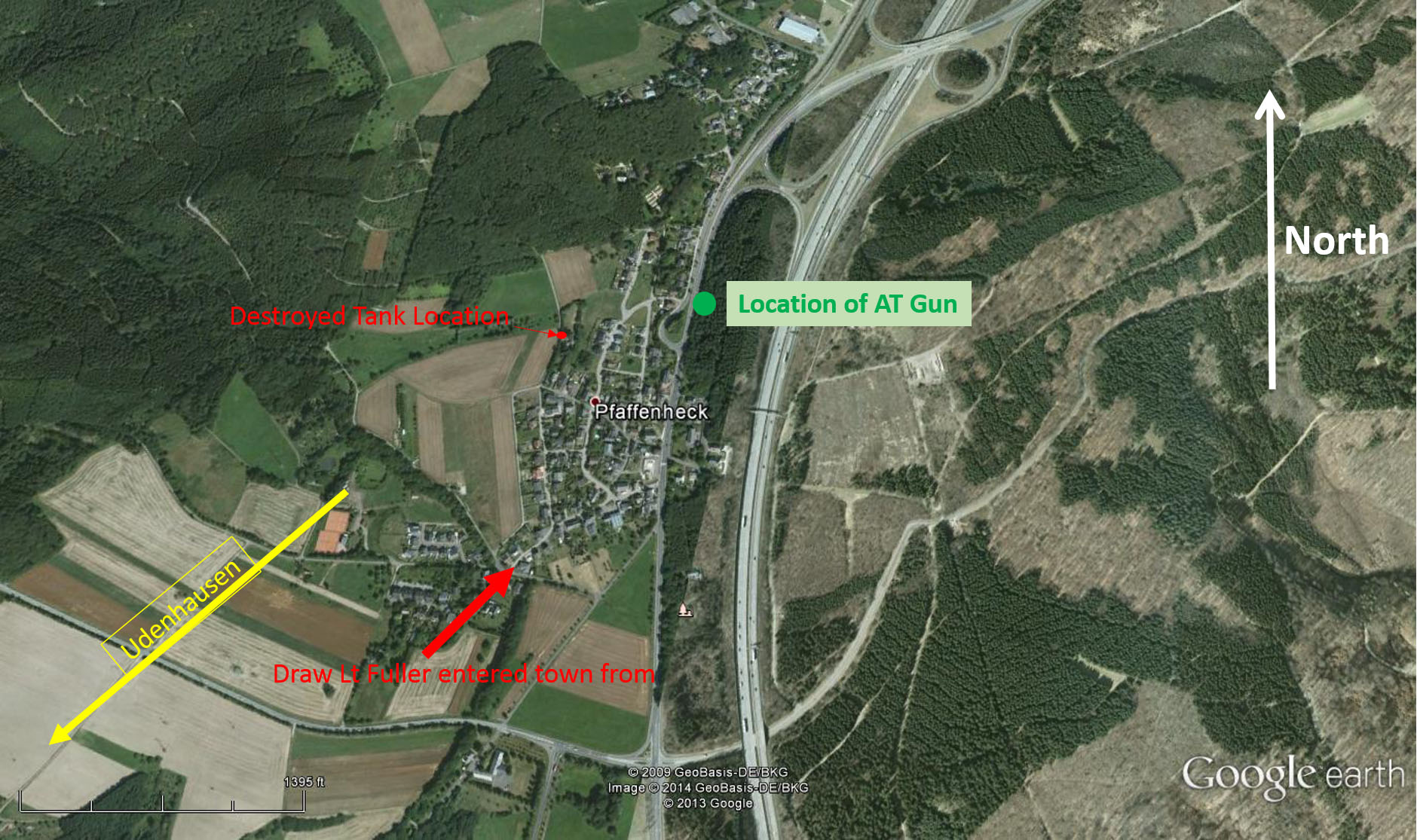
I recently read The Armored Fist a unit history of the US 712th Independent Tank Battalion in WWII.  One of the events described in detail in the book is the Battle for the town of Pfaffenheck in between the Rhine and Moselle rivers in March of 1945.   The event that stuck out at me from the battle was the destruction of an American tank, which killed the driver, Billy Wolfe.  I had the opportunity to visit the town in March, 2014 shortly after the 69th Anniversary of the  battle.

The Battle of Pfaffenheck was fought between soldiers from the 357th Infantry Regiment of the US 90th IN Division, the 2nd Platoon of C Company 712th Independent US Tank Battalion, and German troops of the 6th SS Mountain Division North (Gebirgsjäger).  The 6th SS Division has an interesting history itself.  The unit spent most of the war fighting in Finland and when that country made peace with the Soviets the 6th SS made an overland trek through Sweden to Norway where they transferred to Germany and fought in the Vosges Mountains of northern France over the winter.

Pfaffenheck
Locations of actions in the battle for Pfaffenheck

More after the Jump…

Book Review: The Armored Fist: The 712th Tank Battalion in the Second World War by Aaron Elson

[FULL DISCLOSURE: I received my copy of this book free from the author. I was not paid for this review and the opinion expressed is purely my own] The Armored Fist: The 712th Tank Battalion in the Second World War is one of the best unit histories I have read from WWII.  It is not a traditional unit history in that it is not simply a list of engagements fought, enemy killed, and casualties suffered.  It is a compilation of the recollections of the unit’s members put into chronological order from their first combat to the end of the war.  This is not traditional battle history, instead it is the story … More after the Jump…

The Evolution of Warfare and the Crimea

“History” is a problematic concept because it is very much tied to a specific culture. History departments derive from the medieval university culture of Europe and we have to accept that most people, at most of the time, have lived without any notion of it. Perception is a key to understanding this phenomena: in the history of warfare, violent confrontations have in large part been endemic. Two parties confront each other and display a show of brutal force and often the conflict is resolved symbolically by a single dual or one side is hidden behind a fortification, while tribute is discussed. A perfect example of endemic warfare would be the … More after the Jump…

Book Review: Verdun – The Longest Battle of the Great War by Paul Jankowski

[FULL DISCLOSURE: I received my copy of this book free from the publisher. I was not paid for this review and the opinion expressed is purely my own] Verdun: The Longest Battle of the Great War is one of the flood of new works coming out about World War I this year in commemoration of the 100th anniversary of the outbreak of the world’s first truly mechanized war.  This book explores the ten month (or eleven, depending on how you count it) battle of Verdun between the Germans and French from February to November 1916. It consists of eleven chapters arranged thematically that examine different aspects of the battle from the operational … More after the Jump…

The Makin Raid of 1942 and the Recovery of the Marines Lost After the Battle

In August 1942 the 2nd Marine “Raider” Battalion raided what was then called Makin Island in the Gilbert Archipelago of the South Pacific.  The present name of the island is Butaritari in the island nation of Kiribati.

In 1942 the island had a small, roughly 160 man garrison, and was the site of a Japanese Airfield.  The raid was conceived as a way for the Marines to gather intelligence on what and how many Japanese forces were stationed in the Gilbert Islands.  The plan was for 211 men from companies A and B of the 2nd Marine “Raider” Battalion led by LTC Evans Carlson to land on the island under cover of darkness, neutralize the small Japanese garrison and ransack the island for anything of intelligence value before destroying the facilities and leaving the island.  The Marines would land from two submarines the USS Nautilus and USS Argonaut using small rubber boats equipped with outboard motors.

View of Makin Island from the Periscope of the USS Nautilus Before the Raid

More after the Jump…

Book Review: A Mad Catastrophe by Geoffrey Wawro

[FULL DISCLOSURE: I received my copy of this book free from the author. I was not paid for this review and the opinion expressed is purely my own] A Mad Catastrophe: The Outbreak of World War I and the Collapse of the Habsburg Empire by Dr. Geoffrey Wawro is the first book I have read about WWI that does not treat Austro-Hungary as an afterthought after the outbreak of the fighting in August 1914.  In fact, Austria-Hungary and the course of the fighting in Serbia and Galicia in the first year of the war is the central theme of the book.  Dr. Wawro applies his usual exhaustive research methods to exploring … More after the Jump…