The most important lesson learned/insight to come out of the Ukraine war thus far is the usefulness and battlefield efficiency of drones. Drones are not exactly new, their first combat use dates back to at least the Vietnam war and if you count rudimentary wire-guided missiles World War I.[1] The first combat use of drones in the current meaning is the 2013 fight against ISIS in Iraq and Syria where drones were used in a reconnaissance role. Starting in 2016 or so ISIS pioneered what we now call the drone drop where a simple commercial drone is used to drop explosives or hand grenades on a usually stationary target.
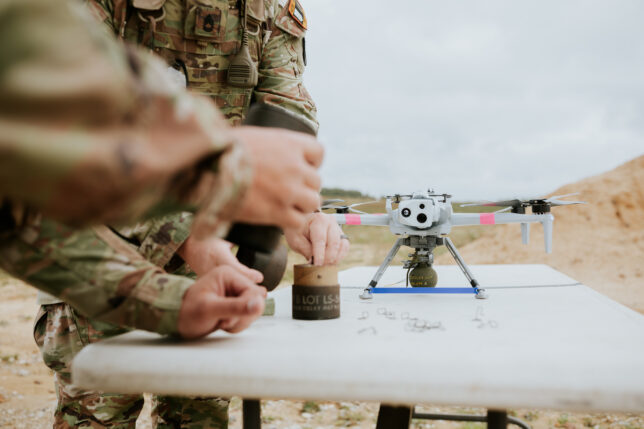
Figure 1: Quadcopter configured to drop hand grenades September 2025: Image Credit US Army, 7th ATC
Many militaries ignored drones or dismissed their combat effectiveness following the substantial defeat of ISIS in 2019. Drones were largely dismissed as being a tactic of the unsophisticated and that drones could not possibly pose a threat to western militaries such as the US or western Europe. This all changed in 2022 with the full-scale Russian invasion of Ukraine.
Drones were not prominent in the opening months of the war, but it rapidly became clear that repurposed civilian drones could play a significant tactical role as force multipliers for the Ukrainians. Since then, the number and type of drones in use by both the Ukrainians and Russians has increased massively. It is similar to watching the development of combat aircraft in World War I in real time.
Combat drones fall into several distinct types:
- Reconnaissance drones – drones used mostly for tactical and operational reconnaissance but also occasionally for strategic recon.
- Tactical munitions dropping drones – the classic grenade dropper that spawned all those cool videos of mostly Ukrainian drones dropping hand grenades on Russian bunkers, vehicles, and occasionally individual soldiers in the first 2 years of the war.
- First-Person View (FPV) drones AKA loitering munitions – These are expendable drones that have a forward-facing camera and varied payloads in which a drone operator finds a target and flies the drone into the target whereupon it explodes hopefully destroying the target. These drones have advanced to the point where some are now semi-autonomous and can continue their mission if they lose the link back to their control station.
- Attack Drones – These are larger, purpose-built medium and long-range drones used in both an operational and strategic capacity, the ones both the Russians and Ukrainians have been using to pound each other’s cities and economic infrastructure.
- Interceptor Drones – The Ukrainians mostly use these. They were developed to take out the Russians most common propeller driven Shahed/Geran drones that fly slow enough to be hit by them.
AT both the tactical and strategic level the use of drones has increased to where drones dominate the battlefield. Just Ukrainian forces conduct up to 9,000 tactical drones strikes per day.[2] That is not counting the hundreds of medium and long-range drones used by both sides in the deep strike capacity. Just in the night of September 19-20, 2026, the Ukrainians launched over 1,000 strike drones at targets in Russia.[3] 1,000 sounds impressive but both sides routinely intercept 80-90% or more of the attack drones launched at them. The trick with attack drones is mass overwhelming defenses. In some ways Stalin was right, “quantity has a quality all its own.”
Drones are here to stay but I would hazard a guess that given the rapid innovation in both drone development and countermeasures, within the next few years drones will be just one additional hazard on the modern battlefield like tanks, artillery, and small arms.
Anti-drone measures are developed almost as fast as innovative ways of employing them. Drone warfare bears watching but so far, they have not been decisive, they serve to stymie maneuver. The real revolution, if you want to call it that, will be when the first person figures out how to reintroduce maneuver to the drone dominated battlefield. The modern equivalent of the introduction of the tank and combined arms tactics in 196-918 opening the way to ending the stalemate on the blood-soaked Western Front. That has not happened yet although I am sure people are working on it.
Below is a good video from Bloomberg examining the evolution of drone use by Ukraine:
[1] Charles S. Oliviero Halton Phil, “The Menace of Misunderstanding: Learning the Wrong Lessons from Ukraine’s Drone-Saturated Battlefields,” Modern War Institute, March 11, 2026, https://mwi.westpoint.edu/the-menace-of-misunderstanding-learning-the-wrong-lessons-from-ukraines-drone-saturated-battlefields/.
[2] Rachael Hoagland, “Build at Scale, Innovate at the Edge, Close the Feedback Loop Fast: Transforming Acquisition for the Drone Age,” Modern War Institute, July 20, 2026, https://mwi.westpoint.edu/build-at-scale-innovate-at-the-edge-close-the-feedback-loop-fast-transforming-acquisition-for-the-drone-age/.
[3] “Ukraine Fires over 1,000 Drones at Russia, Including ‘largest Ever’ Attack on Moscow,” AP News, September 20, 2026, https://apnews.com/article/ukraine-russia-war-drones-moscow-5f7889d027c0247ca2c2c64425b9ffa9.

Leave a Reply