Category Pre-Modern Warfare
Europe in the tenth and eleventh centuries was a continent in transition. The states of Europe were still in flux and the kings of Europe had limited authority outside their own personal demesne. Although individual French kings did… Continue Reading →
I am planning a vacation trip to Malta this summer with my family and like all vacations I take there will be an element of historical tourism involved. I have always wanted to visit Malta and I am finally… Continue Reading →

I wrote a post about Saint John of Nepomuk a week or so ago and at the time I wanted to post a picture of the statue near my house but had been too lazy to stop on my way… Continue Reading →
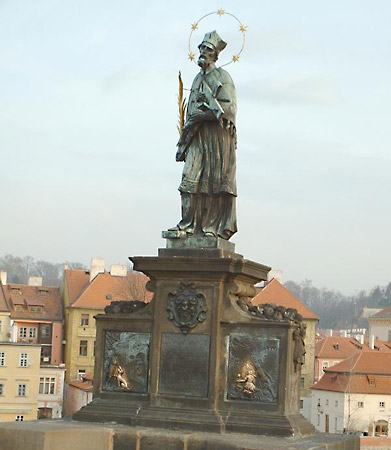
The region of Germany where I live in northeastern Bavaria is locally known as the Oberpfalz or in English the Upper Palatinate. Traditionally, this area was not part of Bavaria but was made up of numerous small separate sovereignties with a… Continue Reading →
The feudal system’s origins can be traced back to late Roman imperial practices of land tenure. The biggest difference between feudal and late Roman practices is the feudal system contained a military obligation in return for holding land. … Continue Reading →
           Beginning in the thirteenth century the Swedes attempted to continue their expansion to the east into the territory of the Lapp people and the Orthodox Russians of Novgorod. They harnessed the rhetoric of Crusade as they expanded to… Continue Reading →
           The people of Northern Germany known as the Wends were not one homogenous people but rather organized themselves in a tribal structure. The tribes from the Saxon border west were the Wagrians, Polabians, Abotrites, Rugians, Liutizians, and Pomeranians.[1] … Continue Reading →
           Pope Innocent III (p.1198-1216), who was perhaps the most ardent supporter of Crusade to hold the Papacy, issued the Papal Bull Quia maior in April 1213 calling for a new Crusade to recapture Jerusalem.[1] This Bull set the standard… Continue Reading →
The Fourth Crusade started in 1202, when Pope Innocent III (p.1198-1216), seeking to build on the success of the Third Crusade preached a new Crusade to recover the Holy city of Jerusalem. The kings of Europe were too involved… Continue Reading →
The weapons and techniques used throughout most of siege warfare are remarkably consistent with few innovations. The notable new weapons were the trebuchet, Greek fire, and Cannons. Â Â Â Â Â Â Â Â Â Â Â Siege towers or belfries were common if unwieldy weapons used at… Continue Reading →
The siege was the most common type of battle fought during the Middle Ages. Medieval armies and commanders tended to avoid pitched battles unless forced into them by circumstances. Medieval warfare and its concentration on sieges can thus… Continue Reading →
The Third Crusade (1189-1192) was launched as a direct result of the loss of Jerusalem to the Muslims in October 1187. The loss of Jerusalem was occasioned by the destruction of the crusaders at the Battle of Hattin on… Continue Reading →
Fortifications have existed since before recorded history and the Middle Ages were no different. Forts and castles were used throughout the Middle Ages as a means of controlling territory and could even be used in an offensive manner such… Continue Reading →
While weapon archetypes used during the feudal period were the same as that used throughout most of recorded history there were changes and developments in the different weapons and armor. Â The spear and all its variants were the most widely… Continue Reading →
           The capture of Salvatierra by the Almohad’s in 1210 provided the impetus for Pope Innocent III (p.1198-1216) to issue a general call for crusade in Spain and grant the remission of sins for those who would go to Spain… Continue Reading →