
The First Crusade

            The First Crusade was arguably the most successful of the various numbered Crusades; however, they were not particularly well equipped for a campaign in Asia Minor.   It is no surprise that they were not, as the climate in Anatolia is completely different from Europe.   What is amazing is the way in which the Crusaders persevered in spite of the hardships they had to endure throughout the march across Asia Minor.  

            The main Crusader army seems to have had an appreciation for the difficulties involved in a march across Anatolia; no doubt; the counsel of the Byzantine emperor, Alexius I Comnenus (1081–1118) was helpful in their choice of march route.   Prior to leaving the region of Nicaea to continue the Crusade, the leaders held a council at Pelekanum where the Frankish leaders and the Alexius discussed further plans for the Crusade.[1]  It was decided that the Crusader army would move as a series rather than together so that there would be more flexibility in deployment, and to simplify logistics.
More after the Jump…

Some Thoughts on Otto von Bismarck

Otto von Bismarck (1815-1898) was probably the most accomplished politician that Germany has ever produced.   He was almost single-handedly responsible for the emergence of the nation of Germany during the nineteenth century.   He was appointed Prime Minister of Germany in 1862 by the Prussian King Wilhelm I (1797-1888) in the middle of a constitutional crisis in Prussia in which the Reichstag refused to authorize a state budget.   Bismarck handled this crisis with ease by using the machinery of state to collect taxes without the Reichstag thus making them irrelevant.   He continued to collect taxes and finance the state for four years until finally the Reichstag was … More after the Jump…

The Actual Writing of a Thesis

I am about 20 pages into writing my thesis and it is killing me.   I generally really enjoy writing, especially writing about history.   I have studied my topic for about 3 years now and actually visited the battlefield twice.   I find myself wanting to hurry writing the introductory chapters so I can get to the good stuff.   It is getting increasingly difficult for me to motivate myself to write, I suppose I will struggle through it somehow though. Writing my thesis is exciting and boring at the same time. The best comparison I can think of is sitting on a screen line in Iraq overwatching a … More after the Jump…

Clausewitzean Ideas of War and how they Relate to Present Conflicts

Clausewitzean Ideas of War and how they Relate to Present Conflicts

As I am getting ready to begin the final class for my MA and complete my Thesis I have been re-reading Clausewitz and his ideas and theory of War.   One of the things that that has struck me the most and made me realize how much Clausewitz is misunderstood is the way in which his most famous quote from the book about how “War is the continuation of policy by other means”[1] is completely taken out of context in most history.

If you read his book further, and I assume that most generals, staff chiefs, and even military historians have then it is clear that this quote is just a starting point given the numerous caveats and expansions on that simple statement in his theory.   Indeed, the very section that this quote heads explains what he means in a very concise and unambiguous manner; it is worth quoting in full.  

“We see, therefore, that war is not merely an act of policy but a true political instrument, a continuation of political intercourse, carried on with other means.   What remains peculiar to war is simply the peculiar nature of its means.   War in general, and the commander in any specific instance, is entitled to require that the trend and designs of policy shall not be inconsistent with these means.   That of course, is no small demand; but however much it may affect political aims in a given case, it will never do more than modify them.   The political object is the goal, war is the means of reaching it, and means can never be considered in isolation from their purpose.”[2]

More after the Jump…

Learning a Language

I was thinking this morning about how important learning a second language is to good scholarship. It hit me because I was not required to learn a second language for my undergrad, I wish I had been. My chosen historical specialty is 18th & 19th century Prussian history. It is kind of hard to see how I could do any really good research without learning German and maybe French. Luckily, I am married to a German woman and had no choice but to learn German if I want to talk to any of my in-laws since most of them don’t speak a lick of English. How could I expect them too since they all live in Germany?
Learning German has stood me in good stead the longer I have been studying history and especially in conducting research for my thesis. I have made several trips to archives in Germany and Austria conducting research for my thesis and these trips would have been completely wasted with no knowledge of German. I probably would not have made them in the first place.

More after the Jump…

The Dreyse Needle Gun

One of the most consistent features of accounts of the German Wars of Unification are the assertions that the Prussian possession of the Dreyse Needle Gun was decisive in and of itself because of its impact on Prussian tactical formation and the flexibility it gave the average infantryman. Make no mistake, the Dreyse was a technological marvel for its time, it indeed gave the Prussians tactical flexibility and radically increased their rate of fire when compared to muzzleloader equipped armies of the time.  The tactical innovations it allowed were few but important.  Perhaps the single most important innovation it allowed was that it allowed the infantry to reload from the … More after the Jump…

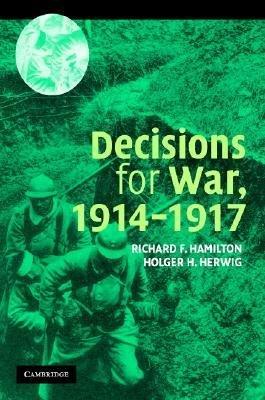
Book Review: Decisions for War, 1914-1917


Decisions for War, 1914-1917

In Decisions for War, 1914-1917, Richard Hamilton and Holger Herwig present a new thesis for the origins of World War I.   They argue that in all the belligerent countries the decision for war was made by a one person or at most a small group of individuals regardless of the type of government.   Given the wealth of material written about the origins of the First World War it seems incredible to me that this possibility has, if not been overlooked in all previous scholarship, then certainly ignored, as the authors claim[1].   While Hamilton and Herwig do not entirely discount that other factors than pure national self-interest on the part of the leaders played a role in the decision for war, they do contend that this was the overriding concern in most if not all of the wars belligerents.

            I found the book to be a fairly easy to read, the writing style was not as dry as might be expected given the topic of discussion.   Even though I do not necessarily agree with the authors, the book was fun and captivating to read.   They write with a style similar to what I try to achieve in my own writing.   It is written such that it is simultaneously engaging, factual, and descriptive, just a good read.   I do not have to agree with a book to enjoy it, and the authors certainly made reading this enjoyable.   It was laid out well and the chapters flowed in a logical progression, discussing each country in the order in which it declared war.  

More after the Jump…

Königgrätz-The battlefield

I went to Königgrätz this past weekend for one final trip before I start writing my thesis and to refresh my memory about what the terrain looks and feels like.  I have found that is difficult to really understand a battle and the course it took unless I have been to the actual battlefield or seen a very good terrain model.  Terrain determines much more about the course of a battle than many people realize.  Of course, rivers and mountains make a difference but so do small terrain features.  Anyone who has ever visited Ypres and stood on top of Passchendaele Ridge looking into the salient can instantly see why … More after the Jump…

BOOK REVIEW: Moltke on the Art of War: Selected Writings

This is the first of a series of book reviews I will put on my blog. Not necessarily because I think anybody cares what I think about a book. The commenters on Amazon certainly don’t. But rather because I think it is helpful for my readers to get an idea of where my knowledge comes from and also because I hope to highlight some great books that are out there that I don’t think a lot of people have read, even history buffs. Most will be good reviews but I do have some books I absolutely think are worthless or despise. I will put those up too. The bottom line … More after the Jump…

Technology and 19th Century War

Here is another subject I was ruminating about this morning and last night. What is the relationship between technology and victory?   This is especially important from the late 18th century forward when the pace of technological innovation in western civilization sped up.  Keep in mind that to the modern mind, change is a constant but that was not always the case, indeed for most of human history it was not the case.  For example, the horse was the main means of transport for 90% of human history, it has only been since the 1840’s since the horse began to be superseded and only really since the 1950’s when the horse … More after the Jump…

The Prussian General Staff

It has often been asserted that one of the things that set the Prussian/German Army apart from others is the General Staff System. I can buy that the Prussian General Staff was the best and has been widely imitated. I don’t know however, if the Staff System itself gave the Germans a decisive edge in warfare. Staff work counts most at the beginning of a conflict and the German experience in WWI shows that even the best staff work and fastest mobilization does not guarantee victory. It can allow a nation to drag a war out but is not a war winning advantage in and of itself. My reading of … More after the Jump…

My MA Thesis-The Battle of Königgrätz -3 July 1866-Part # 3

the present.  This episode is about my visit to the Königgrätz Battlefield in the fall of 2009.  I had actually been bugging my wife to make this trip since we moved to Europe in the summer of 2008 and she finally relented in August of 2009 and surprised me by giving me the itinerary for the trip on our wedding anniversary.  I have dragged my wife many battlefields in both America and Europe during our marriage but I was triply impressed because she actually volunteered to go on this one. We went to Königgrätz the weekend of 26 September, 2009 and it was an adventure the whole way.  We left … More after the Jump…

My MA Thesis-The Battle of Königgrätz -3 July 1866-Part # 2

One of the things about the battle that got me the most was the terrain. One thing I immediately noticed about Austrian dispositions for the battle was that they had refused both flanks and oriented their position on the main road from Königgrätz to Gitschin. It was only the successive hammer blows of multiple Prussian attacks that defeated the Austrians and not superior Prussian technology.  Below is a map of Austrian dispositions before the battle; I know it is hard to really make anything out but I am having trouble getting the full 3mb file uploaded, when I do I will post it. Map from Österreichisches Staatsarchiv-Kriegsarchiv Accession Information: Karton … More after the Jump…

My MA Thesis-The Battle of Königgrätz -3 July 1866-Part # 1

I am currently working on completing my MA in European History.  All I have left to finish is writing my actual thesis which I have been planning for the past 3 years ever since I started my MA program.  I am going to write my thesis about the Battle of Königgrätz during the Seven Weeks War between Austria and Prussia in 1866.  Specifically, my thinking leads me to believe that there is more than the Prussian possession of the Dreyse Needle Gun to account for their victory.  Accordingly, I have been researching this battle and reading books about it for the past 4 years since I wrote my first paper about … More after the Jump…