
Book Review: The Age of Total War: 1860-1945 by Jeremy Black

The notion that a book is “thought-provoking” is often thrown out there for works of non-fiction, and of those that are described as such that I have read most very seldom are.   This book is different, Dr. Black has written not so much a history as a treatise challenging historians, particularly military historians, to reexamine the history of conflict in the examined period with the idea of total war uppermost in their minds.   It seems a counter-intuitive thing to do at first, but he provides plenty of examples of why the wars under consideration were not total or were only partially total at best.   This includes World … More after the Jump…

Photo Essay – Langenbruck Cemetery – Rose Barracks, Vilseck Germany

There is an old German cemetery on Rose Barracks that I have driven past hundreds of times and never stopped to look at. I finally did today and was surprised. I thought it was a military cemetery like the POW cemetery in Grafenwohr but it is not. It is a village cemetery from one of the villages that was moved when the training area was established in the early 20th century. There are several other abandoned villages on Grafenwohr Training Area, most of them are inside the impact area and off limits, there is one other in the maneuver area that still has the shell of a church and has been a reference point that anyone who has ever trained at Graf knows about. Ask anyone who trained at Graf about the Hofenohe Church and they have probably walked through the ruins.

The Cemetery on Rose Barracks is for the village of LangenBruck. As the information panel states, the village dates back to 905. Someone visits the cemetery as there were candles on several of the graves and some of the graves have what looks to be fairly new headstones on them.

I will post the photos below with short explanatory captions.   The photos are compressed due to their large size but if anyone wants the original photos email me and I will be happy to send you a copy of the originals.
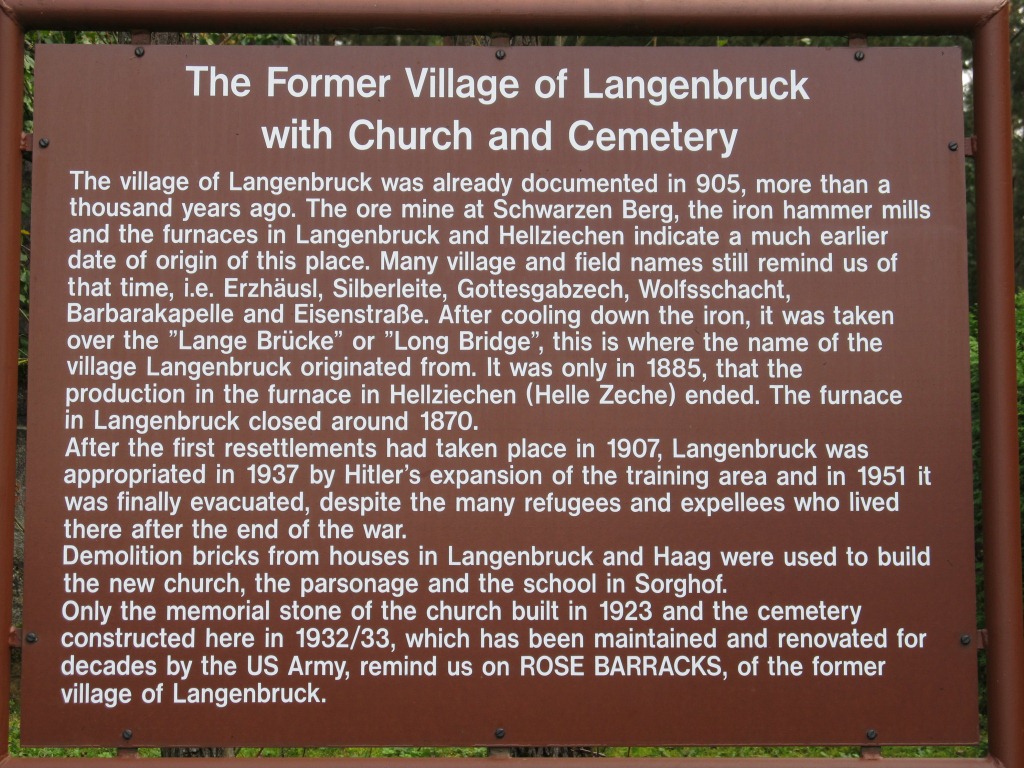
Information panel at entrance to the cemetery.

There are more photos below the fold.

More after the Jump…

S.L.A. Marshall, Men Against Fire, and Whether Men are Conditioned to Kill in Combat or Not.

I am currently reading The Roman Army at War 100 BC – AD 200 by Adrian Kieth Goldsworthy. In the final chapter he talks about the motivation of the Roman soldier to fight. What brings up this topic that starting on page 264 he references S.L.A. Marshall’s (hereafter SLAM) work Men Against Fire: The Problem of Battle Command and repeats the claim that only 25% of men actively participate in combat, the rest being cowards in place at worst or half-hearted fighters at best.   Now, being a recently retired soldier who has seen combat, in Iraq I have several issues with the claim.   In fact, I completely dispute … More after the Jump…

How did the Soviet invasion of Afghanistan impact the Cold War?

As the period of détente during the 1970’s continued, the rapprochement between the Soviet Union and the United States seemed to intensify and promised to lessen tensions between the rival countries.   The invasion of Afghanistan and the imposition of a communist regime seemed to signal that the communists had not abandoned their dream of global conquest.   This caused the United States to renew their efforts to halt the communist expansion by supporting the Afghan rebels in their efforts to expel the Russians. After the Soviet invasion, progress towards furthering friendly relations between the west and Soviets halted and even moved backwards.   Ronald Reagan, the newly elected American … More after the Jump…

The God Clause

I ran across a piece in Bloomberg Businessweek that is very interesting. The God Clause and the Reinsurance Industry It is a fairly long story but the gist of it is that reinsurer’s, companies that essentially insure insurance companies, have some very sophisticated models for assessing risk but even they are not omniscient when it comes to natural events. The way these companies caegorize risk is interesting in the extreme. Lloyds of London has an entire section of their website devoted to analyzing risk and they annually put out a list of Realistic Disaster Scenarios.   What I found most interesting were the examples in the story of the way … More after the Jump…

China: A Potential or Current Threat?

Jed Babbitt has an excellent piece on RCP today that talks about the potential threat China represents to the US and by implication, the rest of the Western world.China’s Economic Sword.   People have been pointing to the potential threat China poses for at least the past twenty+years and are almost invariably poo-pooed as being unrealistic and that China does not pose a threat to the US they just want to modernize and bring the fruits of that modernization to their own people.   I tend to think that China is indeed a threat and a threat we in the West ignore at our own peril. There are several developments … More after the Jump…

BOOK REVIEW: Civilization: The West and the Rest by Niall Ferguson

I have read several of Niall Ferguson’s books and while I may not always agree with him hi writing style and analysis are always interesting and thought provoking.   Civilization: The West and the Rest is no different.   I have the UK edition of the book, I doubt it is significantly different from the US edition except for the cover, but cannot guarantee it. In this book Dr. Ferguson attempts to analyze and explain why the West, which he defines as European and countries with a European heritage, has prospered so much over the past 500 years and how the West managed to control so much of the globe. … More after the Jump…

The Fronts of World War I in 1917 & 1918

The tactical and strategic situation at the beginning of 1917 was little changed from that at the beginning of 1916.   All that the offensives on the Western Front had managed to accomplish the previous year were minor changes in the trace of the trenches and massive loss of life.   Both the British and French planned further offensives in the west during the years but events would intervene to ensure that only the British committed themselves to large-scale offensives on the Western Front in 1917. The spring and summer saw the French army undergo a crisis of confidence that has come to be known as the French mutinies, thought … More after the Jump…

Book Review: The Face of Battle by John Keegan

I have to caveat this review somewhat.   I wrote this book review for an undergrad military history course I took almost six-years ago.   I still think that the The Face of Battle is an excellent book.   I have modified my opinion of Keegan as a historian somewhat though.   I think he is somewhat overrated and he tends to simplistic British-centric judgements in his analysis of military history.   He is a good historian, but sometimes his interpretations of events are not all they could be. “The Face of Battle” by John Keegan has become a classic in the thirty years since it was published.   The … More after the Jump…

Military Uniforms

As I was getting ready for work this morning I started thinking about military uniforms and what their purpose is. I have heard all the typical reasons such as discipline, Esprit de Corps, identification, distinctiveness, economy, and of course, uniformity. The more I thought about it the more it hit me that the main reason for a uniform and also the most practical one to my mind is that of battlefield identification or simply being able to tell friend from foe. I think the discipline and Esprit parts of having a uniform are natural outgrowths but are not essential as elements. Uniforms have been around for literally thousands of years … More after the Jump…

The American Way of War – My Opinion

The American Way of War was introduced as a concept by Russell Weigley in his book of the same name during the early 1970’s.   Essentially the theory runs that America attempts to totally dominate her enemies in war thus ending the war.   The American method of achieving this during and since World War II has been through the judicious application of firepower; that is, overwhelming force directed against an enemy. American doctrine as it developed during and after World War II stresses the use of maximum force at the point of decision.   This is not much different from other nations doctrine, what makes it different is the … More after the Jump…

Dazzle Camo

A Mrs. Nora Holloway from the Military Gear Blog (Opennes Note:  The blog links to an an online store so it could be subtle spam)sent me an email a few days asking me to share an article she wrote concerning the history and possible future use of Dazzle Camoflage on military ships and vehicles.   She posits that perhaps there may be a resurgence in the use of dazzle camo based on recent research showing it is marginally effective in low-tech environments.   Dazzle Camo was used extensivley on ships in WWII but for some reason I highly doubt that it will make a comeback. Painting and repainting military vehicles … More after the Jump…

Battle Analysis-The Ludendorff Offensives of Spring 1918

In the spring of 1918 the German army attempted a series of war winning offensives on the Western Front that ultimately were to fail and their failure led directly to the German signing of an armistice in November of 1918.   The failure of the Ludendorff offensives as they were known was strategic and operational in nature.   The German army had devised a new tactical system and doctrine that broke the stalemate of the Western front.   What they could not do was follow through once the front had been broken. The Germans had developed the tactical system known as infiltration in response to the stalemate of trench warfare. … More after the Jump…

D-day: The 67th Anniversary

None of us in America should forget D-day, today 67th anniversary of the opening of the Second Front against Hitler in WWII.  The national archives has an excellent page with a election of documents and photographs related to that day.  Her are some photos that will hopefully provoke some refection on the sacrifices of our grandfathers and what has been characterized as “The Greatest Generation.”  And a link to the text of an excellent speech by Ronald Reagan on the 40th Anniversary: The Boys of Pointe du Hoc Let us never forget our men and women in uniform.