
I am about half convinced a this point given the level of rhetoric that the first open Russian incursion into eastern Ukraine will happen by the end of the month. I would guess it will be an aerial incursion, probably a helicopter gunship that crosses the border and penetrates 15-20 km’s. At this point I would not b surprised if Russia orchestrated somebody firing on said incursion to give causus belli.
 Patrick Shrier
How History Repeats Itself
I apologize in advance for the blatantly political tone of this piece but I am flabbergasted by what I see happening on the eastern periphery of Europe and the anemic reaction to state on state aggression by the rest of the world.
I read this piece by Justin Logan from the Cato Institute this morning and was struck immediately on how similar in tone this piece is to the rhetoric of the pre-WWII America Firsters. Is Estonia Worth a War?
I just ask myself are people so blind or so willing to seek peace at any cost that they will not stand up to tyranny until the cost of stopping it is orders of magnitude greater than if they had stood up for principle at the beginning? The same kinds of arguments against involvement in WWII were made by isolationists in the US and appeasers abroad as Hitler’s Germany slowly re-armed and swallowed its neighbors in the years prior to WWII.
Largely the same process is in action in Russia today. Whereas Germany felt slighted and unjustly treated after WWI modern Russia feels slighted and mistreated after the unsatisfactory (from their perspective) end to the Cold War. It is interesting that roughly a generation passed between 1918 and 1939 and roughly a generation has passed between 1989 and 2014. Russia was stripped of large swaths of territory in the wake of the fall of communism and Germany was stripped of territory, actually split into two separate blocks by the Danzig Corridor, in the wake of Versailles. The German people felt they were not defeated, (hence the popularity of the stab in the back myth), while many Russians today feel that they were betrayed from within by Gorbachev and Co. Hitler was an ideologue that fed on and amplified public perceptions of being unjustly handled by the Allies and Putin has done the same in Russia. As Germany expanded it was only weakly opposed by the Allied powers and we are seeing the same sort of reaction in the West to Putin’s actions.
History seems to be repeating itself before our eyes as yet another European ideologue and dictator forges ahead towards war and an attempt to dominate its neighbors. Is the West going to stand idly by and allow it to happen again until the cost of stopping it is immeasurably higher? The stakes are higher this time around because Russia is a nuclear power. The time to stop Putin and Russia is now and a serious demonstration of Western resolve would achieve without bloodshed what will costs thousands, if not millions of lives later on.
Has the West learned nothing from history other than that War is bad? There are things worse than war, and if the Western leadership does not find their spine soon they will see what those things are.
Glossary of Modern Military Terms
Engage the Enemy means “to blow something up.”
Surgical Strike means “to blow up something small.”
Decapitate means “to blow up their leaders.”
Collateral Damage means “to accidentally blow up something of theirs.”
Friendly Fire means “to accidentally blow up something of ours.”
Target of Opportunity means “to blow something up on a whim”
Kinetic Targeting means “to blow up something that’s moving”
Ordnance is “something that that does the blowing up”
An Asset is “something that can be blown up”
Embedded Media means “a report that’s blown out of proportion”
The Battle of Mantinea
The Battle of Mantinea was part of the Great Peloponnesian War (430-404 B.C.). The war was fought in an effort to defeat and contain the growing power of Sparta in Greek Affairs. The war was ultimately a failure as Sparta won in the end and dictated terms to Athens and her allies in the process guaranteeing that Athens would not dominate the Greek world. The prelude to the battle itself was a gathering of Argive Alliance troops who attacked Tegea, about 5 miles south of Mantinea. The Spartans rallied to Tegea’s defense and began to divert a stream to flood Mantinean territory. The main source for the course of the … More after the Jump…
Book Review: No End Save Victory by David Kaiser
[FULL DISCLOSURE: I received my copy of this book free from the author. I was not paid for this review and the opinion expressed is purely my own] No End Save Victory: How FDR Led the Nation into War is one of those books that at first glance looks like it is going to be one of those dry, difficult to read history books that is nothing more than a litany of dates and facts. Nothing could be further from the truth. It is an interesting and compelling account of the events in America during the 18 months prior to American entry into WWII. Oddly, this period is mentioned in every … More after the Jump…
The Battle of Pfaffenheck – 15-17 March 1945
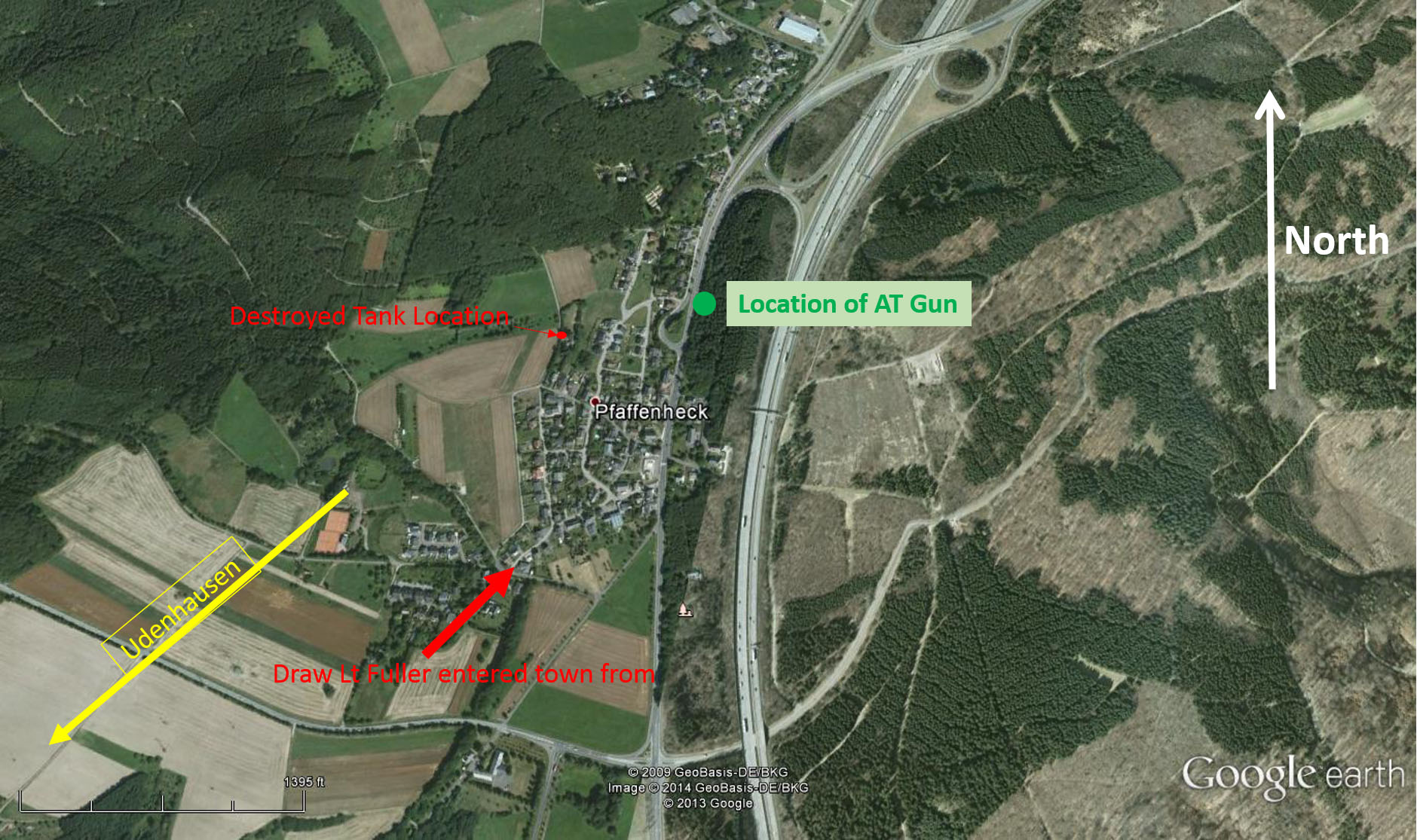
I recently read The Armored Fist a unit history of the US 712th Independent Tank Battalion in WWII. One of the events described in detail in the book is the Battle for the town of Pfaffenheck in between the Rhine and Moselle rivers in March of 1945. The event that stuck out at me from the battle was the destruction of an American tank, which killed the driver, Billy Wolfe. I had the opportunity to visit the town in March, 2014 shortly after the 69th Anniversary of the battle.
The Battle of Pfaffenheck was fought between soldiers from the 357th Infantry Regiment of the US 90th IN Division, the 2nd Platoon of C Company 712th Independent US Tank Battalion, and German troops of the 6th SS Mountain Division North (Gebirgsjäger). The 6th SS Division has an interesting history itself. The unit spent most of the war fighting in Finland and when that country made peace with the Soviets the 6th SS made an overland trek through Sweden to Norway where they transferred to Germany and fought in the Vosges Mountains of northern France over the winter.
Book Review: The Armored Fist: The 712th Tank Battalion in the Second World War by Aaron Elson
[FULL DISCLOSURE: I received my copy of this book free from the author. I was not paid for this review and the opinion expressed is purely my own] The Armored Fist: The 712th Tank Battalion in the Second World War is one of the best unit histories I have read from WWII. It is not a traditional unit history in that it is not simply a list of engagements fought, enemy killed, and casualties suffered. It is a compilation of the recollections of the unit’s members put into chronological order from their first combat to the end of the war. This is not traditional battle history, instead it is the story … More after the Jump…
Memorial to Allen Mosteiro
In the early 90’s I served with Allen Mosteiro in the scout platoon from 1/8 CAV, 1st Cavalry Division. We were roommates and party mates and served together for three years. Our platoon was called the Ghostriders and as a platoon we worked hard and played hard. My three years there from 92-95 were some of my best years in the army and I have stayed in contact with many of my brothers in the Ghostriders since, both those who stayed in the Army and those who got out.
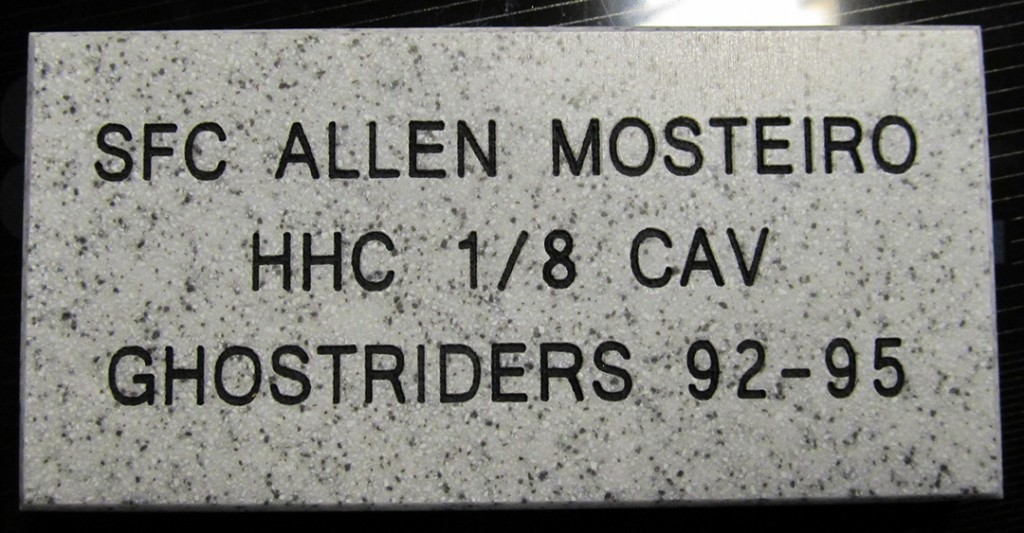
Mosteiro was one of those who stayed in. We did not serve together again but I did run into him a few times over the coming years. In 2007 while serving as a Platoon Sergeant in 1/7 Cav he was killed in Taji, Iraq by a sniper. The word quickly went out to our fellow Ghostriders. He was buried in the Central Texas State Veterans Cemetery just outside of Killeen, Texas. I happened to be stationed at Forth Hood at the time and could go to the funeral as a representative of his old platoon, the Ghostriders.
Last year, I discovered the National Armor and Cavalry Heritage Museum was conducting a fundraiser to help defray the costs of building their new museum and selling memorial pavers. I quickly contacted all my old Ghostrider brothers to float the idea of buying one for Allen. It was not a question and we all came together and purchased one. Last week, I got the miniature paver in the mail to show what the full-size paver will look like.
Allen is not forgotten by his former comrades and will always remain our brother.
Book Review: Verdun – The Longest Battle of the Great War by Paul Jankowski
[FULL DISCLOSURE: I received my copy of this book free from the publisher. I was not paid for this review and the opinion expressed is purely my own] Verdun: The Longest Battle of the Great War is one of the flood of new works coming out about World War I this year in commemoration of the 100th anniversary of the outbreak of the world’s first truly mechanized war. This book explores the ten month (or eleven, depending on how you count it) battle of Verdun between the Germans and French from February to November 1916. It consists of eleven chapters arranged thematically that examine different aspects of the battle from the operational … More after the Jump…
One Smart Private
As a platoon of trainees stood in formation at an Army Base, the Drill Sergeant walked up and said, “All right! All you retards fall out.”
As the rest of the platoon wandered away, one soldier remained at attention.
The Drill Sergeant walked over until he was eye-to-eye with him, and then raised a single eyebrow.
The soldier smiled and said, “Sure was a lot of ’em, huh, Drill Sergeant?”
Book Review: Power Games by Richard Peters
[FULL DISCLOSURE: I received my copy of this book free from the author. I was not paid for this review and the opinion expressed is purely my own] I get 5-10 requests a month from publishers and authors to review their books here on B&BR and usually accept 3-4 of them because I don’t have as much time to read as I would like. When Richard Peters, the author of Power Games: Operation Enduring Unity I contacted me and inquired about reviewing his book I had a stack of 5 other books I was working through and initially almost turned him down for lack of time. Man, am I glad I did … More after the Jump…
The Makin Raid of 1942 and the Recovery of the Marines Lost After the Battle
In August 1942 the 2nd Marine “Raider” Battalion raided what was then called Makin Island in the Gilbert Archipelago of the South Pacific. The present name of the island is Butaritari in the island nation of Kiribati.
In 1942 the island had a small, roughly 160 man garrison, and was the site of a Japanese Airfield. The raid was conceived as a way for the Marines to gather intelligence on what and how many Japanese forces were stationed in the Gilbert Islands. The plan was for 211 men from companies A and B of the 2nd Marine “Raider” Battalion led by LTC Evans Carlson to land on the island under cover of darkness, neutralize the small Japanese garrison and ransack the island for anything of intelligence value before destroying the facilities and leaving the island. The Marines would land from two submarines the USS Nautilus and USS Argonaut using small rubber boats equipped with outboard motors.

Book Review: A Mad Catastrophe by Geoffrey Wawro
[FULL DISCLOSURE: I received my copy of this book free from the author. I was not paid for this review and the opinion expressed is purely my own] A Mad Catastrophe: The Outbreak of World War I and the Collapse of the Habsburg Empire by Dr. Geoffrey Wawro is the first book I have read about WWI that does not treat Austro-Hungary as an afterthought after the outbreak of the fighting in August 1914. In fact, Austria-Hungary and the course of the fighting in Serbia and Galicia in the first year of the war is the central theme of the book. Dr. Wawro applies his usual exhaustive research methods to exploring … More after the Jump…
Taliban Capture a War Dog
The Taliban capture a British dog of war Just before Christmas last year the Taliban in Afghanistan apparently captured a British War Dag and true to form have posted a capture video of it. Now that is going too far. I wonder if they are torturing the dog and trying to get information out of it. It would not surprise me if they were. The dog appears to be a Belgian Malinois, one of the favorite breeds for working dogs because they are smart, diligent, and not easily distracted from their tasks. There is apparently some confusion as to whether it is a British or American dog. As the article … More after the Jump…
The Difference between Officers and NCO’s
A Platoon Sergeant and his Platoon Leader are racking out in the field for
the night. The Platoon Sergeant looks up and says, “When you see all the
stars in the sky, what do you think, LT?”
The LT replies, “Well, I think of how insignificant we really are in the
universe; how small a piece of such a grand design. I can’t help but wonder
if what we do truly means anything or makes any difference. Why? What do
you think of, Sergeant?”
“I think somebody stole the freakin’ tent.”