
Reading and Military Service

There is an interesting piece on Medium.com recently about basic training and encouraging new soldiers to read.  I read, and read a lot, and have always tried to encourage others to read, not only my fellow soldiers when I was in the Army, but people in general. I find that the idea of having a reading list and free copies of said books available to basic trainees to read in their less-than-copious free time is an awesome idea and I am chagrined that I did not do it when I was a Drill Sergeant at Fort Knox many years ago. I don’t necessarily agree with all the titles on the … More after the Jump…

The Hattin Campaign and the Triumph of Saladin in 1187

Medieval politics make modern politics look like child’s play.  If any act from medieval times highlights this it is the Hattin Campaign of 1187 in which the entire military might of the Christian Kingdom of Jerusalem was destroyed because the Christians themselves collectively acted stupidly due to internal political factors in the face of an existential external threat.  The final campaign of the Kingdom of Jerusalem is best seen as an object lesson of what happens when you let internal politics direct external actions. In 1186 Guy de Lusignan became king of Jerusalem through his wife Sibylla after the death of Baldwin V while in his minority.  The coronation was … More after the Jump…

The First Battle of Manassas – 21 July, 1861

First Manassas or First Bull Run as it was called in the North was the first major battle between land forces of the Civil War.  The outcome of the battle also set the general pattern for battles in the first two years of the war. That pattern being tactical Union defeats with the Confederacy being incapable of following up on the strategic opportunities presented by their victories. Forces Involved: Union – 28,450 troops under BG Irvin McDowell Confederate – 32,230 under BG Joseph Johnston and BG P.G.T. Beauregard A key point is to remember that uniforms were not standardized on either side this early in the war. Both armies looked … More after the Jump…

The Battle of Messines Ridge – 1917

From the opening months of the World War I, Flanders was the decisive sector for the British Army.  It was in an around the medieval Belgian town of Ypres that the original BEF had decimated themselves fending off German attacks from October to December, 1914.  Ypres and the salient surrounding it was where the British would see the hardest and most prolonged fighting of all the places where the British would fight in World War I. The Battle of Messines Ridge fought from 7-14 June, 1914 was not really a separate battle at all but rather the opening phase of what would come to be known variously as the Third … More after the Jump…

Book Review: The Bombers and the Bombed: Allied Air War Over Europe 1940-1945 by Richard Overy

[FULL DISCLOSURE: I received my copy of this book free from the author. I was not paid for this review and the opinion expressed is purely my own] The Bombers and the Bombed: Allied Air War Over Europe 1940-1945 is one of those books that is going to end up a standard work for a long time to come.  It is the single most comprehensive history of the Allied bombing of Germany and occupied Europe during WWII that I have seen since the strategic bombing survey published by the US government in the immediate post-war years. I have a review copy of the book so the page counts may be a … More after the Jump…

The Battle of Antietam – 17 September, 1862

The Battle of Antietam is interesting for several reasons the most important of which for me is that it is the single bloodiest day in American military history. There have been bloodier battles in American wars but no single day matches the blood spilled on those Maryland fields that early day in 1862. The Union victory at Antietam, if you can call it a victory, also provided Abe Lincoln with the opportunity to promulgate the Emancipation Proclamation. An executive act that was totally unconstitutional but that he did anyway for domestic and foreign political reasons. Antietam was the final battle of Lee’s first invasion of the North and while it … More after the Jump…

Book Review: No End Save Victory by David Kaiser

[FULL DISCLOSURE: I received my copy of this book free from the author. I was not paid for this review and the opinion expressed is purely my own] No End Save Victory: How FDR Led the Nation into War is one of those books that at first glance looks like it is going to be one of those dry, difficult to read history books that is nothing more than a litany of dates and facts.  Nothing could be further from the truth.  It is an interesting and compelling account of the events in America during the 18 months prior to American entry into WWII.  Oddly, this period is mentioned in every … More after the Jump…

The Battle of Pfaffenheck – 15-17 March 1945

I recently read The Armored Fist a unit history of the US 712th Independent Tank Battalion in WWII.  One of the events described in detail in the book is the Battle for the town of Pfaffenheck in between the Rhine and Moselle rivers in March of 1945.   The event that stuck out at me from the battle was the destruction of an American tank, which killed the driver, Billy Wolfe.  I had the opportunity to visit the town in March, 2014 shortly after the 69th Anniversary of the  battle.

The Battle of Pfaffenheck was fought between soldiers from the 357th Infantry Regiment of the US 90th IN Division, the 2nd Platoon of C Company 712th Independent US Tank Battalion, and German troops of the 6th SS Mountain Division North (Gebirgsjäger).  The 6th SS Division has an interesting history itself.  The unit spent most of the war fighting in Finland and when that country made peace with the Soviets the 6th SS made an overland trek through Sweden to Norway where they transferred to Germany and fought in the Vosges Mountains of northern France over the winter.
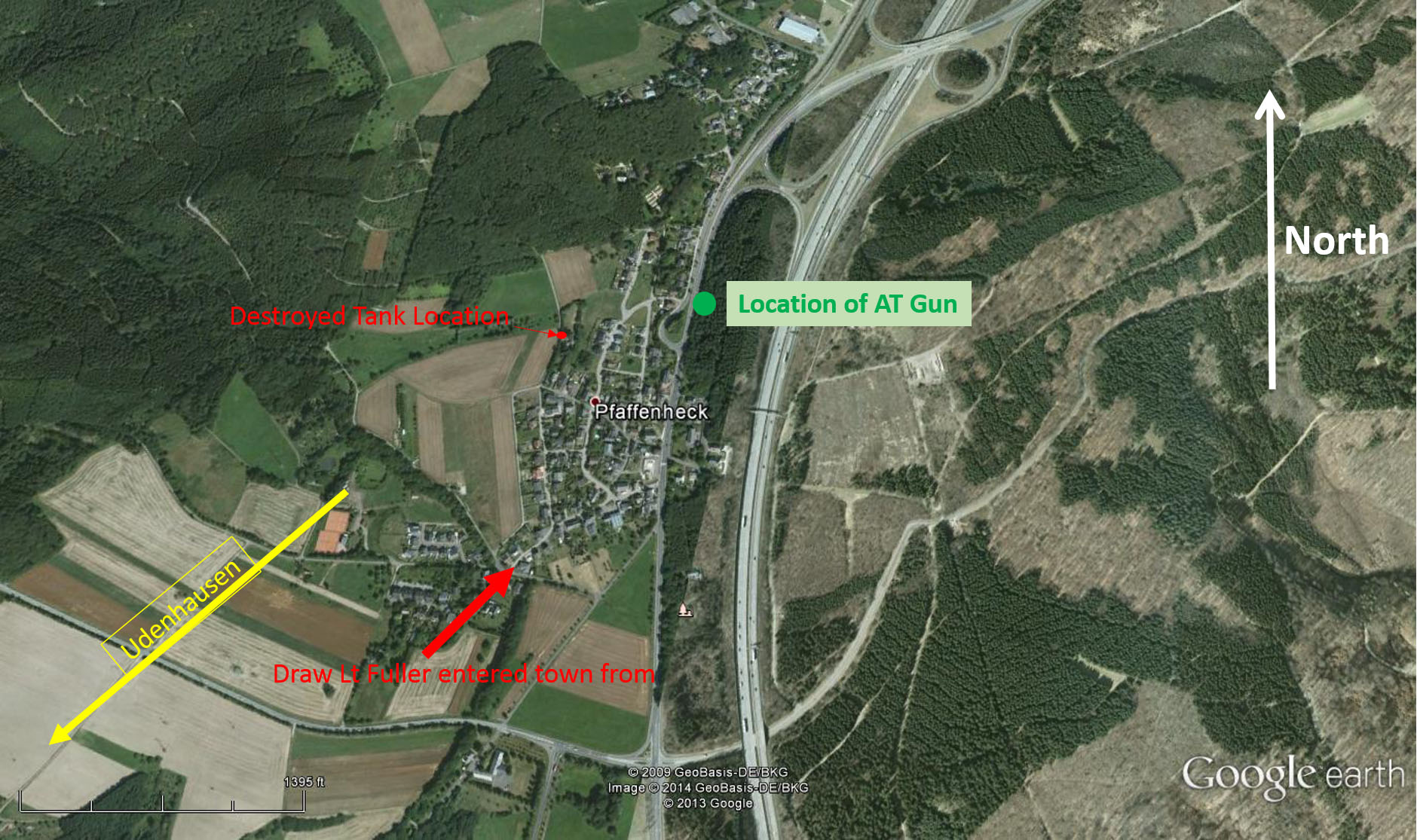
Pfaffenheck
Locations of actions in the battle for Pfaffenheck

More after the Jump…

Book Review: Verdun – The Longest Battle of the Great War by Paul Jankowski

[FULL DISCLOSURE: I received my copy of this book free from the publisher. I was not paid for this review and the opinion expressed is purely my own] Verdun: The Longest Battle of the Great War is one of the flood of new works coming out about World War I this year in commemoration of the 100th anniversary of the outbreak of the world’s first truly mechanized war.  This book explores the ten month (or eleven, depending on how you count it) battle of Verdun between the Germans and French from February to November 1916. It consists of eleven chapters arranged thematically that examine different aspects of the battle from the operational … More after the Jump…

The 9th Company – Film Review

The 9th Company is the Russian Full Metal Jacket. It starts of in bootcamp and ends in an inhospitable landscape fighting guerillas in unconventional warfare. It is a fictional portrayal of The Battle for Hill 3234. That being said, the value of this film lies in what can be gleaned not from the similarities with the former film, but with the differences. First of all, we are introduced to Russian culture in the form of dedovshchina, a term which encapsulates the institutions of the former Soviet Union ( and which continue to this day). Russian hierarchies have their cultural inheritance in the gulag, and in The Bitch Wars. A brutal, … More after the Jump…

The Makin Raid of 1942 and the Recovery of the Marines Lost After the Battle

In August 1942 the 2nd Marine “Raider” Battalion raided what was then called Makin Island in the Gilbert Archipelago of the South Pacific.  The present name of the island is Butaritari in the island nation of Kiribati.

In 1942 the island had a small, roughly 160 man garrison, and was the site of a Japanese Airfield.  The raid was conceived as a way for the Marines to gather intelligence on what and how many Japanese forces were stationed in the Gilbert Islands.  The plan was for 211 men from companies A and B of the 2nd Marine “Raider” Battalion led by LTC Evans Carlson to land on the island under cover of darkness, neutralize the small Japanese garrison and ransack the island for anything of intelligence value before destroying the facilities and leaving the island.  The Marines would land from two submarines the USS Nautilus and USS Argonaut using small rubber boats equipped with outboard motors.

View of Makin Island from the Periscope of the USS Nautilus Before the Raid

More after the Jump…

The Crete Campaign: 20-29 May, 1941

Last Spring I did a presentation to my local Military History group about the Crete Campaign of 1941 and figured that since I now have the time I would put something up here about it as well because I find the whole campaign to be a comedy of errors by both sides in this misguided, ill-conceived, and poorly executed excuse for a battle. First, we should examine the strategic situation in May of 1941.
In May 1941 England had been run out of Greece with its tail between its legs and was using Crete as both a staging ground for evacuation and they were hoping like hell they could hold it and stop the Mediterranean, or at least the eastern part from turning into a German Lake. For their part, Germany did not know what to do. They were in the last stages of planning the attack on Stalin’s Russia set to commence in June but in the meantime they had all these troops hanging out in Greece with nothing to do. The possession of Crete would have conferred no strategic or even operational advantage to the Germans as the British still controlled Malta and the British navy still controlled the waters of the Mediterranean Sea.

More after the Jump…

A rebuttal to “Killology”

In the past 100 years man has gone from a man, to a killer ape, to a man again. I find it hard to believe that he ever was a killer or lover of mankind, but more like a hungry creature who needed a reason to do anything other than satiate himself. First of all, we don’t have evidence to prove that the Battle of Gaugamela was “a giant shoving match.” We do have evidence that modern soldiers have misfired their rifles on purpose in order to avoid shooting the enemy, but many conclusions can be drawn from this. I would argue that Europeans have gone through four stages in … More after the Jump…

Book Review: Nightfighter: Radar Intercept Killer by Mark A. Magruder

[FULL DISCLOSURE: I received my copy of this book free from the author. I was not paid for this review and the opinion expressed is purely my own] Every time I think that nothing more can be written about WWII that is both interesting and informative a book like this one makes an appearance.  I will even be upfront and admit that I don’t normally go in for biographies or autobiograhies of famous people, much less someone who is not a household name.  Nightfighter: Radar Intercept Killer by Mark A. Magruder has caused me to reevaluate both opinions. This book is the story of USMC COL Marion Magruder, one of the … More after the Jump…

Book Review: Battle Tactics of the Western Front by Paddy Griffith

Battle Tactics of the Western Front: The British Army`s Art of Attack, 1916-18 by Paddy Griffith is a very interesting book. The premise is that despite what many historians have said about the inertia of the British Army in WWI and it’s resistance to tactical change, that is not true and the British were committed to innovation throughout the war in an effort to break the deadlock of the trenches. The book itself is not long, 219 pages of text including appendices. There are extensive endnotes and the bibliography is fairly extensive as well. The book is organized topically and though it purports to only deal with the developments of the … More after the Jump…